A
Digital twin
Reduced-order FE model of the structure, updated from measurements.

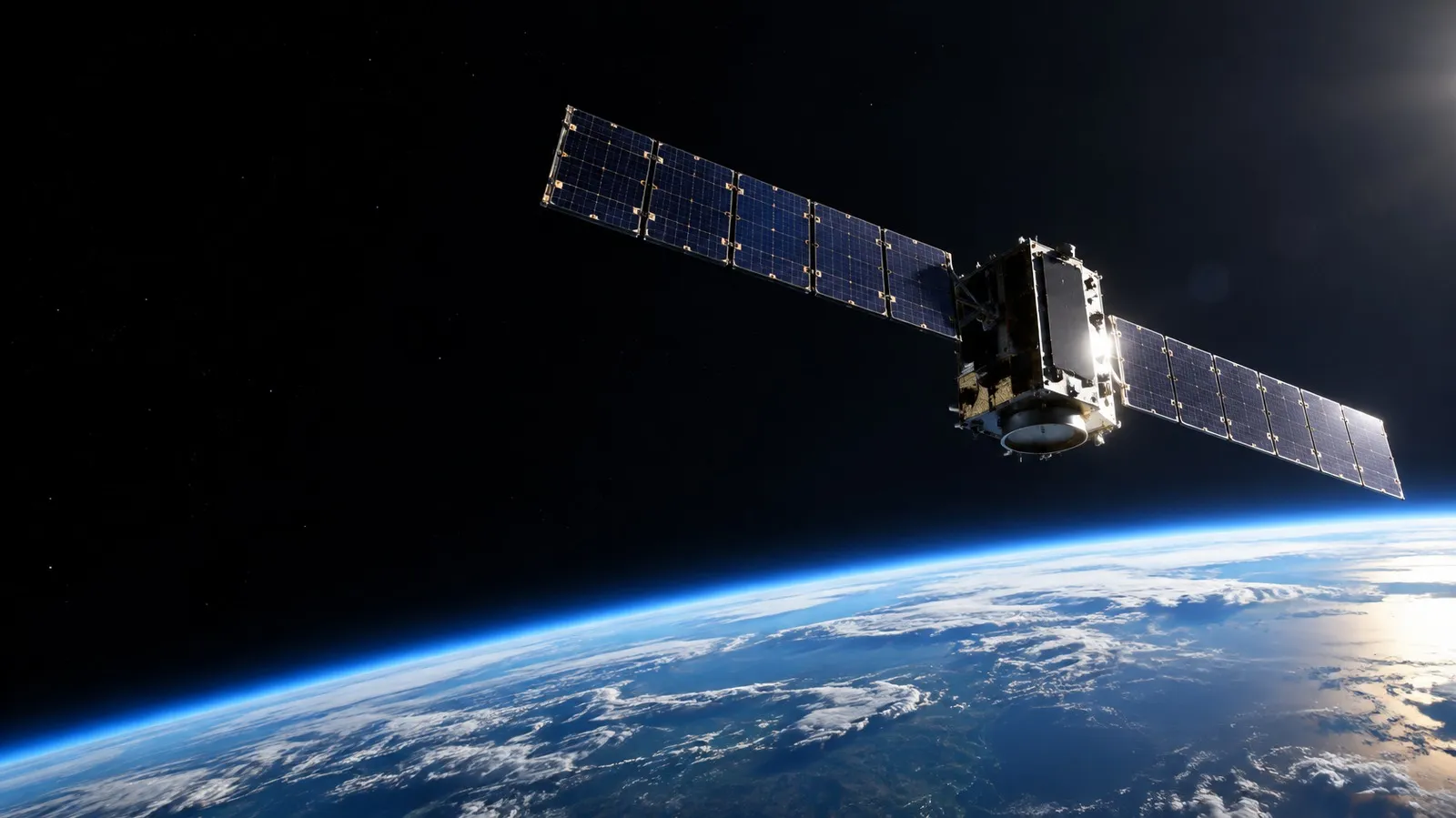
Visualisation
Project
Hevelia is a research and development project that aims to enable reliable assessment of the mechanical condition of large deployable satellite structures from limited indirect measurements.
Modern satellites increasingly rely on multi-segment solar arrays, deployable reflector antennas and lightweight booms. They must be light and compact, so they have low stiffness, complex dynamics, and respond to manoeuvres, temperature changes and wear in their mechanical joints.
Today an operator knows a great deal about a satellite’s attitude, temperatures and subsystems. Far less about whether its structure behaves as designed. Hevelia aims to close that gap.
Problem
Technology
We read structural condition from the response of the whole satellite, through a physical model.
Reduced-order FE model of the structure, updated from measurements.
Gyroscopes, attitude, temperatures, optionally cameras.
Inverse identification, Bayesian estimation, machine learning.
When data are insufficient, we show a range of possible explanations instead of guessing.
Application
We are analysing how to detect changes in panel joint dynamics from attitude determination and control system (ADCS) data.
qualification and acceptance testing
assessment immediately after deployment in orbit
monitoring throughout the mission
Results
Physically grounded knowledge of a satellite’s condition.
In the baseline approach, no. We use data the satellite already collects: gyroscopes, attitude and temperatures.
Conventional SHM requires sensors on the component itself. Hevelia infers condition indirectly: from the response of the whole platform, through a physical model.
No. Machine learning operates within physical constraints, together with inverse identification and Bayesian estimation.
The system says so explicitly and indicates the range of possible explanations.
On a laboratory test rig we introduce known changes and measure them with an independent reference configuration.
The project will run for 30 months and aims to bring the technology to TRL 4, with a path to TRL 5.
We are looking for industrial and research partners, and operators. Let’s talk about data and integration.
[TO BE COMPLETED: e-mail]
Hevelia Sp. z o.o. · Sopot